


Duda’s white label lets an agency sell websites under its own brand. Clients log into a dashboard with your logo, edit in an editor with your colors, and get reports and emails that never mention Duda. For agencies that sell websites alongside SEO, ads or local marketing, it removes the platform from the conversation and keeps the client relationship with you.
White labeling the platform is only half the picture, though. Someone still has to design, build and maintain every site. This guide covers what Duda’s white label actually includes, how the Agency and White Label plans handle client workflows, how templates help you scale production, and when it makes sense to outsource the builds themselves.
What Duda White Label Includes
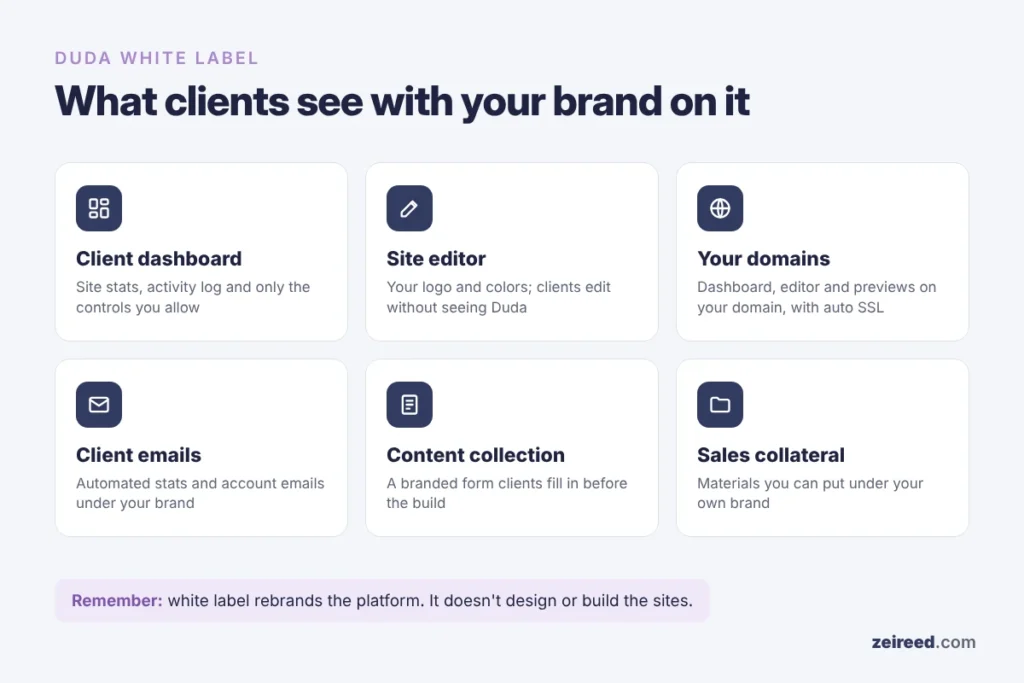
Duda’s white label features rebrand the parts of the platform your clients see. According to Duda, that covers:
- A branded client dashboard showing site stats, an activity log and only the controls you allow
- A branded editor with your logo and colors, so clients can make edits without seeing Duda’s name
- Your own domains for the dashboard, editor and site previews, with SSL certificates generated automatically
- Branded client communication, including automated emails with site stats and account instructions
- A branded content collection form clients fill in before you start building
- Sales collateral you can put under your own brand
Duda’s pricing page lists the White Label plan at USD 199 a month, or USD 149 a month billed annually, with four sites included; additional sites are billed separately. The Agency plan (USD 69 a month, or USD 52 annually) includes the same number of sites and team seats but not the branded experience. [REVIEW: re-check duda.co/pricing before publishing; plan details change.]
The important distinction: white label rebrands the platform. It doesn’t design or build anything. That part is still your team’s job, or a partner’s.
The Agency Plan and Client Workflows
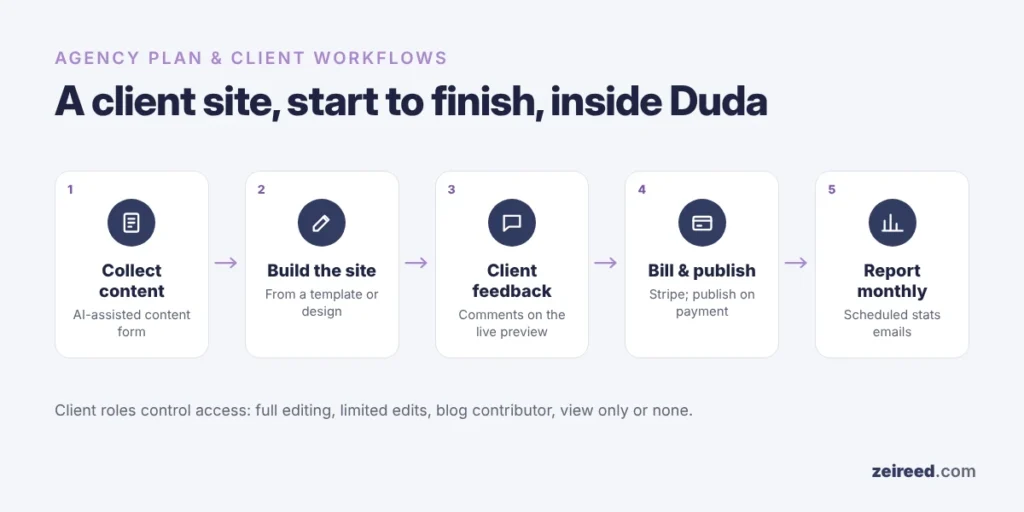
Most of what makes Duda useful to agencies is client management, which is available on Duda’s team-oriented plans, not only White Label. The features that matter day to day:
Client accounts and permissions
You invite each client to their site with a role. Duda’s permissions are granular: full editing, limited edits, a blog-contributor role, view-only access or no access at all. You can also create custom roles. In practice, most agencies give clients permission to update text, images and blog posts while locking layouts and global styles, which prevents the “client broke the homepage” support ticket.
Content collection
Instead of chasing clients for logos, photos and copy over email, you send a content collection form. Duda can generate industry-specific questions with AI and use the answers to populate a site. Submitted content shows up inside the editor, ready to place.
Feedback and approvals
Clients can leave comments directly on the site in the editor or on a live preview, and you get notified by email or through Zapier. It replaces long email threads with feedback attached to the exact section it refers to.
Client billing
Duda’s client billing runs through Stripe. You can charge one-time fees for design work or recurring fees for hosting, maintenance or SEO, and tie site status to payment: publish after the first payment, or unpublish if payments stop. Duda says it adds no fees beyond Stripe’s processing fees, and checkout and billing emails can carry your branding.
Automated reporting
Scheduled emails send clients site performance metrics such as page views. For clients on a monthly retainer, that is a regular reminder of the value you provide, without anyone building a report by hand.
Templates and Scaling Site Production
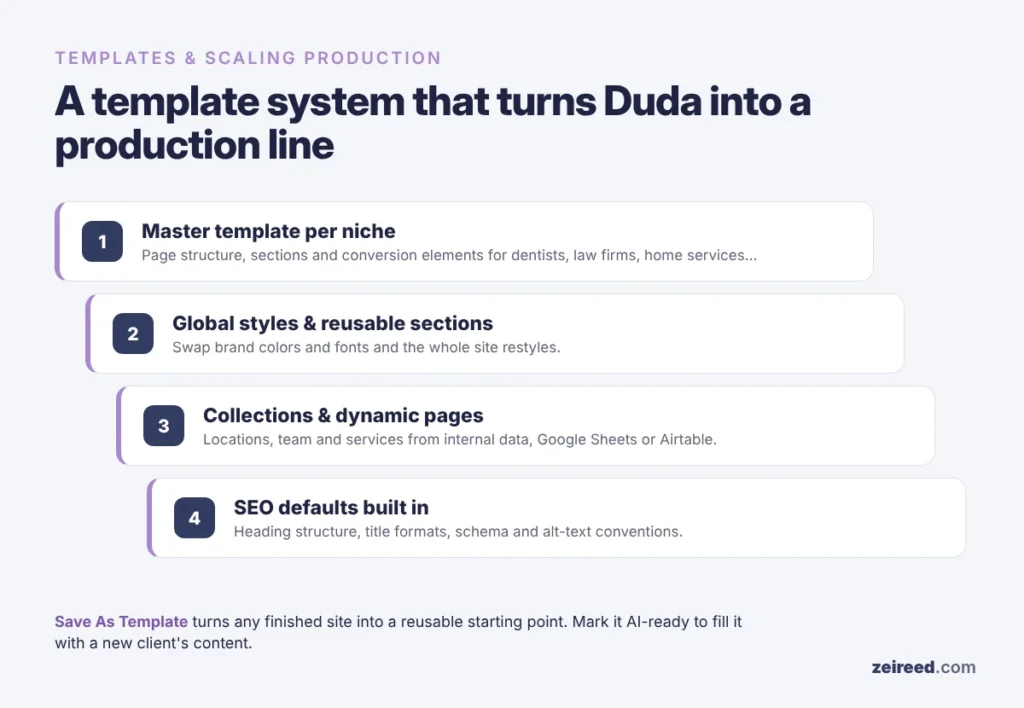
Templates are how agencies turn Duda from a website builder into a production line. Duda offers a library of ready-made Duda website templates, but the real gain comes from custom templates built around your niche.
You can save any finished site as a custom template (Sites › three-dot menu › Save As Template) and start new client sites from it. A template can also be marked “AI-ready,” so Duda’s AI fills it with a new client’s content, while elements you lock stay as designed. Custom templates are available only within the account where they were saved.
A practical template system for an agency looks like this:
- One master template per niche, such as dentists, law firms or home services, with the page structure, sections and conversion elements that work in that industry.
- Global styles and reusable sections, so swapping brand colors and fonts restyles the whole site in minutes.
- Collections and dynamic pages for content that repeats: locations, team members, services. Duda can pull this data from internal collections, Google Sheets or Airtable.
- SEO defaults built in: heading structure, title formats, schema and alt-text conventions, so every new site starts from a solid base. Our Duda SEO checklist covers what to include.
Two cautions. Duda advises against creating templates from multi-language sites. And a template only speeds you up if someone maintains it; an outdated master template quietly copies old problems into every new client site.
In-House vs. Outsourced Duda Builds
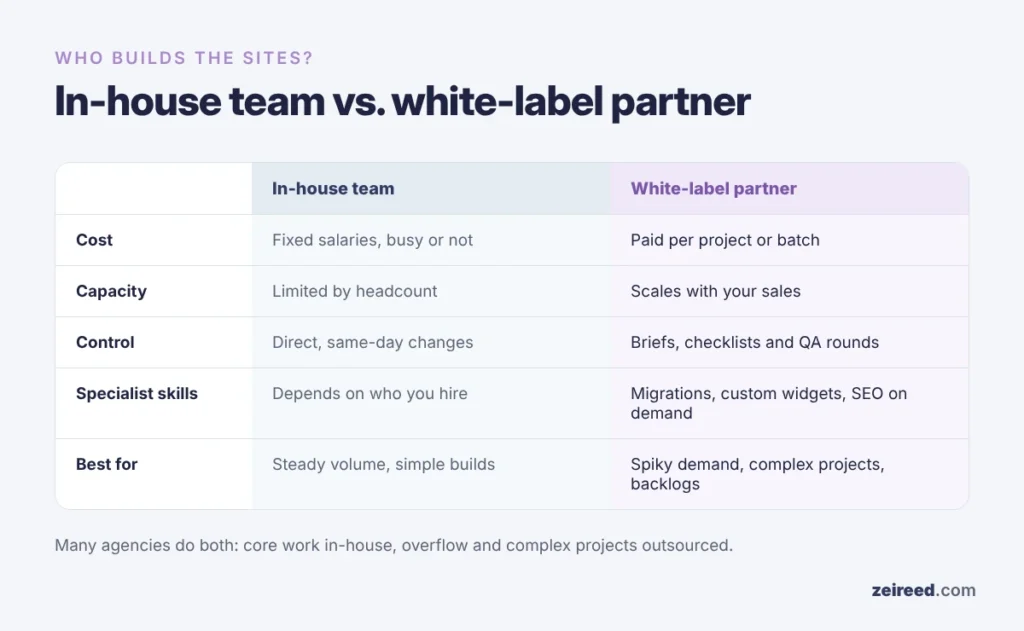
Once the platform side is set up, the question is who builds the sites. There is no single right answer; it depends on your volume, your margins and how predictable your pipeline is.
| Factor | In-house team | Outsourced white-label partner |
|---|---|---|
| Cost structure | Fixed salaries, whether projects come in or not | Paid per project or batch |
| Capacity | Limited by headcount; hiring takes months | Scales up or down with your sales |
| Control | Direct, same-day changes | Through briefs, checklists and QA rounds |
| Specialist skills | Depends on who you hire | Custom widgets, migrations and SEO setup available when needed |
| Best for | Steady, high volume with simple builds | Spiky demand, complex projects or a backlog |
Outsourcing usually makes sense when:
- Sales outpace delivery. You’re turning work away, or clients wait weeks for a start date.
- A project is outside your team’s comfort zone. Multi-location sites, migrations from WordPress, custom widgets or complex integrations.
- You’re migrating your client base to Duda. Duda’s own guidance describes migration as largely a rebuild, which is labor-intensive and easy to hand off.
- Your designers should be designing. If senior staff spend their week on production work, a partner frees them for sales and strategy.
Keeping builds in-house makes sense when your volume is steady, the sites are simple and template-based, and you already have the people. Many agencies do both: core work in-house, overflow and complex projects outsourced.
How a White-Label Partnership Works With Us
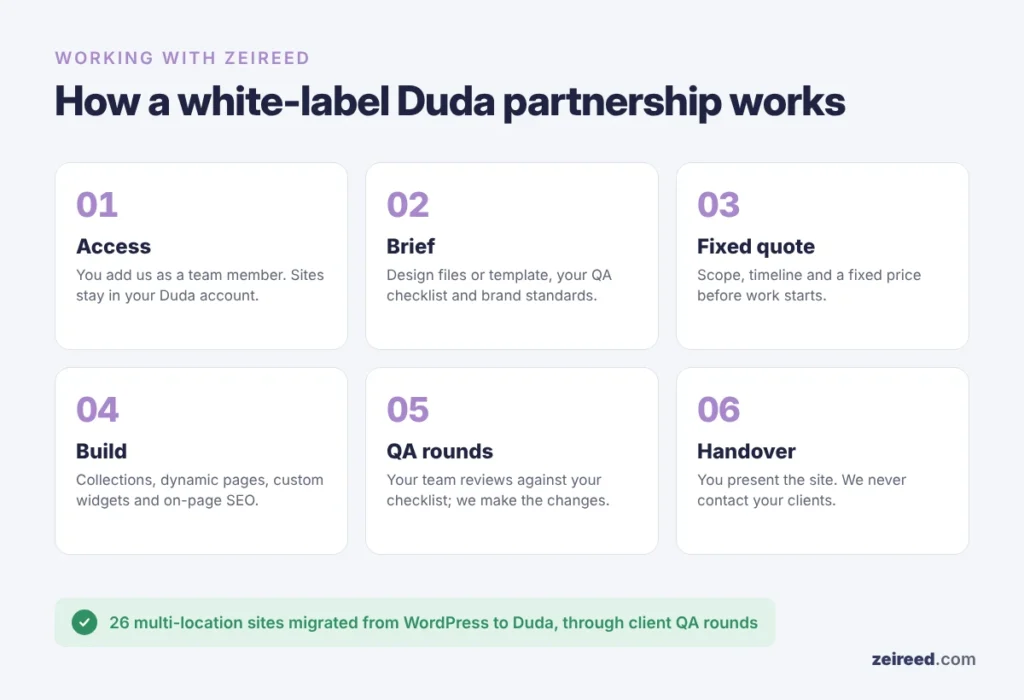
Zeireed works as a behind-the-scenes Duda production team for agencies. Here’s how a typical engagement runs:
- Access. You add us as a team member in your Duda account. Sites stay in your account, under your brand.
- Brief. You send the design files, template or brief, plus your QA checklist and brand standards.
- Fixed quote. We confirm scope, timeline and a fixed price before work starts.
- Build. We build the site, including Collections, dynamic pages, custom widgets and integrations where needed, and set up on-page SEO.
- QA rounds. Your team reviews against your checklist; we work through the changes.
- Handover. You present the site to your client. We stay invisible and never contact your clients unless you ask us to.
Our most extensive Duda work so far has been for exactly this kind of setup: we’ve migrated 26 multi-location funeral home websites from WordPress to Duda, rebuilding location pages and dynamic staff profiles and working through the client’s QA rounds on each. See the projects in our Duda portfolio, or read more about our white-label Duda development services.
Agency Partner Program
Send us your next Duda build. Share the brief or design files and we’ll come back with a fixed quote, a timeline and how we’d fit into your workflow.
Join the agency partner program
FAQ
Does Duda offer a white label website builder?
Yes. Duda’s white label features let agencies brand the client dashboard, editor, preview domains and client emails with their own logo and colors, so clients don’t see Duda’s name. It’s offered on Duda’s White Label plan and higher.
How much does Duda’s White Label plan cost?
Duda’s pricing page lists the White Label plan at USD 199 per month, or USD 149 per month billed annually, with four sites included. Additional sites cost extra. Check Duda’s pricing page for current rates.
What’s the difference between Duda’s Agency and White Label plans?
Both include multiple sites, team seats and client management. The White Label plan adds the branded experience: your logo and colors on the dashboard, editor and client communication instead of Duda’s.
Can I create my own Duda website templates?
Yes. You can save any site as a custom template and start new client sites from it. Templates can be set as AI-ready so Duda fills them with a client’s content. Custom templates are available only in the account where they were saved.
Can I bill clients through Duda?
Yes. Duda’s client billing uses Stripe for one-time and recurring payments, and can publish or unpublish a site based on payment status. Duda says it adds no fees beyond Stripe’s processing fees.
Will my clients know a partner built their site?
Not if you don’t want them to. A white-label partner works inside your Duda account, under your brand, and doesn’t contact your clients directly.


Join the conversation
No comments yet — share a question or your own experience. Your email stays private.